With ocean conservation at the heart of its mission, the Museum of
Underwater Art, situated on the ocean floor in the middle of the Great
Barrier Reef, blends art with reef restoration in hopes of inspiring
positive environmental action among visitors.
World leading underwater sculptor Jason deCaires Taylor is the
creative mastermind behind the museum’s art installations. He works in
tandem with other local community artists to create symbolic and
poignant sculptures to exhibit within the Great Barrier Reef itself to
convey the importance of reef restoration.
Visitors who wish to view these underwater masterpieces can snorkel
or dive within the area and interact with the sculptures either by
themselves or via the Museum of Underwater Art’s approved dive
operators. These underwater trails can cater to leisure snorkelers,
certified divers and even first-time divers.
One of the museum’s first installations is the Ocean Siren, a
colour-changing humanoid sculpture erected in the waters alongside North
Queensland’s Strand Jetty in Townsville. The Ocean Siren reacts to live
water temperature data and changes colour in response to live
variations in water temperature.
The largest installation in the museum is titled the Coral
Greenhouse, filled with 20 reef guardians which have been specially
created with stainless steel and PH-neutral materials for corals to be
planted on. It also houses Jason deCaires Taylor’s first-ever underwater
building.
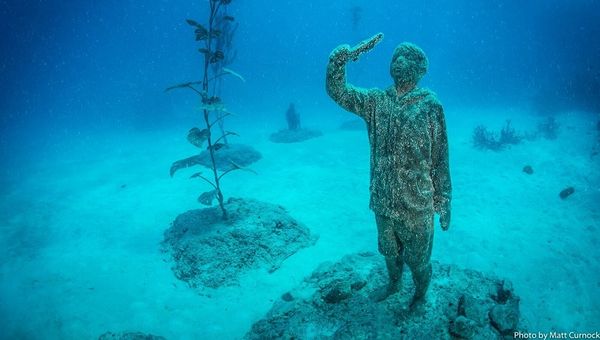
“I hope that in years to come a variety of endemic species such as corals, sponges and hydroids will change the sculptures' appearance in vibrant and unpredictable ways,” said the museum’s artist. Photo Credit: Museum of Underwater Art
The Ocean Sentinels is the latest installation in the series
featuring eight imposing and stoic creatures seemingly made up of both
the sea and land. Each standing 2.2m tall, these aquatic humanoids are
deemed the protectors of the Great Barrier Reef.
They are currently part of an on-land exhibition at the Museum of
Tropical Queensland from March to May, where visitors can get an
opportunity to see them in their raw, pristine form before they are
brought to their permanent underwater home in June to undergo a dramatic
transformation by nature.
The surfaces and forms of the artworks are designed to be colonised
by marine life. It is hoped that over the course of several years,
corals, sponges and other marine life will thrive on these sculptures
and change their appearance — transforming them into a living and
evolving part of the ecosystem.
Paul Victory, the Museum of Underwater Art’s Board Director, said the
exhibit is about connecting with as many people as possible, to spark
meaningful conversation around the Great Barrier Reef and its future.
“The chance to see the world-class sculptures in the flesh and learn
about their stories, promoting reef conservation and the link between
art and science to a wider audience, is incredible,” Victory shared.
“This unique exhibit allows the public to enjoy and experience the next
stage of the Museum of Underwater Art and learn about the important work
we've been doing with coral planting, reef health surveys, providing
education and work opportunities for Indigenous guides, and more.”
The Museum of Underwater Art is predicted to attract more than 50,000
visitors annually, and generate over A$22m (US$16m) each year for
Townsville’s visitor economy. This unique tourist attraction is a timely
move that can help spur Australia’s tourism recovery following its
border reopening, and further capture the influx of travellers when they
visit the country during the 2032 Olympic and Paralympic Games.